Seeking Alpha vs MarketWatch: Which Platform Serves Investors Better?
Seeking Alpha vs MarketWatch – Seeking Alpha delivers deep research and Quant Ratings while MarketWatch offers live news and real-time market data. Compare both now.

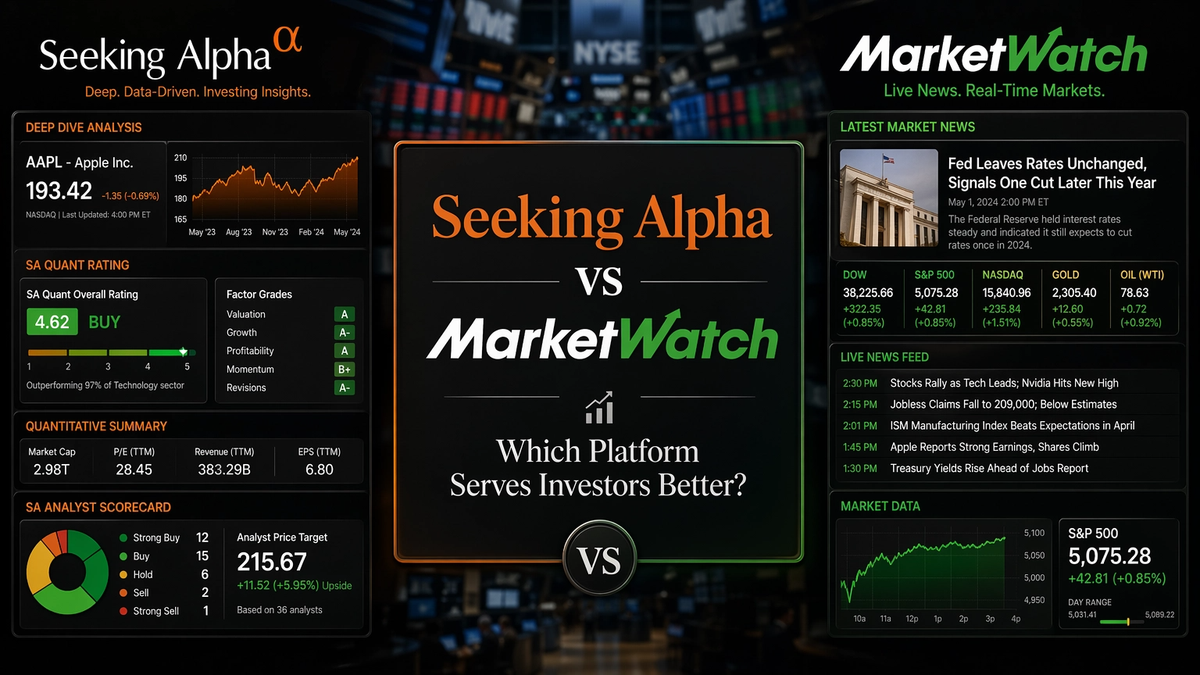
Seeking Alpha vs MarketWatch – Seeking Alpha Quant Ratings and deep dive analysis compared to MarketWatch live news feed and real-time market data for investorsSeeking Alpha and MarketWatch are two of the most visited financial platforms in the United States, yet they were built for very different purposes. MarketWatch is a news-first outlet that keeps investors up to date on breaking developments. Seeking Alpha is a research-first community that helps investors evaluate stocks before committing capital. Choosing between them — or understanding how to use both — starts with knowing what each one is actually built to do.
Background: Who Owns Them and What Are They?
MarketWatch is a subsidiary of Dow Jones & Company, which is itself owned by News Corporation. The company also owns and publishes Barron's and the Wall Street Journal. The MarketWatch website first launched in 1997 and was acquired by Dow Jones & Company in January of 2005. The core offerings of MarketWatch include financial news, market data, stock quotes, analysis, and investment insights.
Seeking Alpha got its start back in 2004, when it was founded by a former Morgan Stanley technology analyst named David Jackson. It has partnerships with MarketWatch, CNBC, MSN, and The Street, among others. Simply stated, Seeking Alpha is an investment community that uses a crowdsourced model for investment research, opinions, and analysis.
The ownership structure is a meaningful difference. MarketWatch sits inside one of the most established journalism organizations in finance. Seeking Alpha operates independently, relying on a contributor network rather than a newsroom.
Content: News vs. Deep Research
This is where the two platforms diverge most clearly.
MarketWatch provides comprehensive coverage of financial markets, including stocks, bonds, commodities, and cryptocurrencies. It offers real-time news updates, stock quotes, and market data. The website features expert financial analysis and commentary, offering insights into market trends and investment strategies.
Seeking Alpha takes a different approach. Subscribers get access to articles and research from expert analysts, along with research and portfolio management tools and crowdsourced opinions from other Seeking Alpha users. The platform includes user-generated articles by investors, analysts, and financial professionals, plus stock ratings including Bullish and Bearish ratings from contributors, Wall Street Analysts' ratings, and Seeking Alpha's proprietary Quant ratings.
In short, MarketWatch tells you what is happening in the markets today. Seeking Alpha tells you whether a specific stock is worth owning — and why.
Unique Strengths of Each Platform
MarketWatch differentiates itself with a market data hub that includes stock and market screeners, mutual fund research, fund comparison, and multi-quote lookup tools. It also offers personal watchlists available free with an account that sync across web and mobile apps with customizable price and news alerts, plus comprehensive event calendars covering U.S. economic releases, corporate earnings, IPO schedules, and options-expiration dates.
Seeking Alpha stands out for its Quant Ratings for stocks with five Factor Grades — Value, Growth, Profitability, Momentum, and EPS Revisions — plus ETF Factor Grades covering Momentum, Expenses, Dividends, Risk, and Liquidity. It also offers stock and ETF screeners with ratings, grades, and advanced filters, and the ability to compare up to 20 stocks side by side with export to Excel or PDF.
Stock Rating Systems
MarketWatch does not have a proprietary stock rating system in the same way Seeking Alpha does. Since MarketWatch does not have proprietary ratings, a true apples-to-apples comparison with Seeking Alpha's Quant system is not possible.
Seeking Alpha's Quant Rating system has a documented performance record. Its Quant ratings use metrics including value, growth, profitability, EPS revisions, and price momentum to assign each investment a rating between 1 and 5. A hypothetical investor who put $10,000 into the S&P 500 back in 2010 would have increased their portfolio to $57,416 by 2024. By contrast, an investor who bought Seeking Alpha Strong Buy rated stocks would have $278,192 — nearly five times the return.
Who Each Platform Is Built For
Beginner investors and those with only a casual interest in the stock market may prefer MarketWatch. It offers some research tools, most of which are linked to market news rather than in-depth resources such as a company's financials.
Experienced and intermediate investors, as well as portfolio managers and serious traders who have some knowledge about investment metrics and want access to as much data and information as possible, are more likely to prefer Seeking Alpha. Seeking Alpha offers 10 years of financials for publicly traded companies, plus a huge library of analysis from both investment experts and community members, widely-respected Quant ratings, and advanced screening and portfolio management tools.
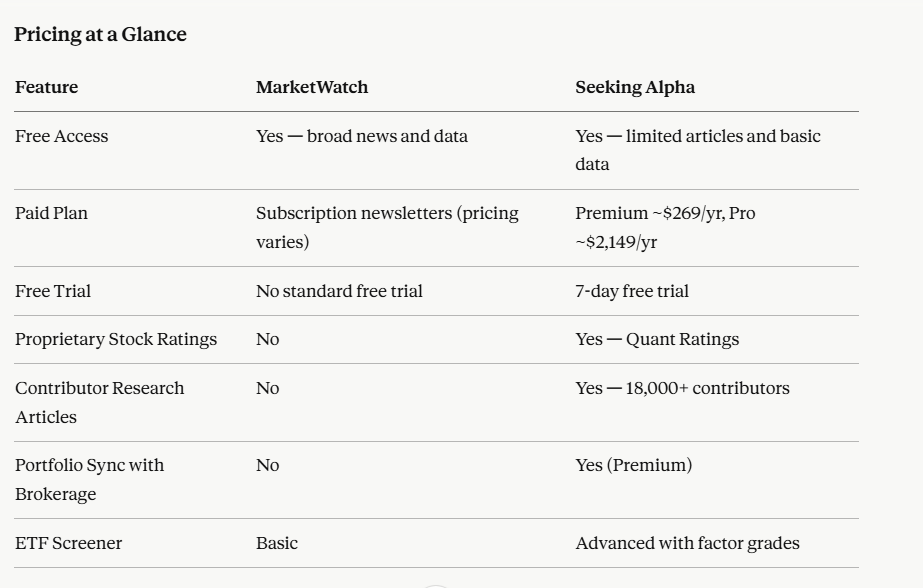
Both MarketWatch and Seeking Alpha keep freemium access with optional paid upgrades, so you can trial each platform before committing. Both also support web and mobile access, making it easy to keep tabs on research away from the desk.
Overlapping Features
Despite their different focus areas, the two platforms do share meaningful common ground. Both platforms cover news, alerts, calendar events, screeners, data visualizations, watchlists, financials, options, ETF overview and holdings, and analyst price targets.
Where they diverge is in depth. MarketWatch covers all of these at a surface level that is accessible and fast. Seeking Alpha goes much deeper on each — particularly on individual stock analysis, fundamental data, and proprietary ratings.
People Also Ask
Q: Is Seeking Alpha better than MarketWatch?
Seeking Alpha's premium content is best suited to help long-term investors with a passion for research, while MarketWatch provides free and low-cost real-time updates that are most useful for short-term traders and people who want to stay current on breaking financial news. Neither is objectively better — they serve different investor needs.
Q: Is MarketWatch free to use?
Yes, for the majority of its content. MarketWatch offers both free and subscription-based services depending on the features you want. Most of its news, market data, stock quotes, and basic watchlist tools are available at no cost. Certain newsletters and premium content sections require a paid subscription.
Q: Who owns MarketWatch?
MarketWatch, along with The Wall Street Journal and Barron's, is owned by Dow Jones & Company, a prominent American publishing firm and subsidiary of News Corp. This gives MarketWatch the editorial resources and journalistic standards of one of the most well-known financial media organizations in the world.
Q: What does Seeking Alpha offer that MarketWatch does not?
The most significant differences are Seeking Alpha's Quant Ratings, its contributor research library, and its advanced portfolio and screening tools. Seeking Alpha includes exclusive categories such as ETF screeners with factor grades, stock comparison tools for up to 20 securities, earnings transcripts, dividend analysis, Bulls Say / Bears Say breakdowns, and detailed analyst forecast data that MarketWatch does not cover.
Q: What does MarketWatch offer that Seeking Alpha does not?
MarketWatch adds coverage of paper trading, insider data, short interest tracking, interest rates, yield curves, IPO calendars, and specialized newsletters that Seeking Alpha skips. It is also stronger for macro-level coverage including economic policy, personal finance, and retirement planning — areas where MarketWatch's professional journalism team dedicates significant resources.
Which Platform Should You Use?
The answer depends entirely on what you need at a given moment.
If you want to know what is moving the market right now, understand the macroeconomic context behind price action, or track a wide range of asset classes including bonds, currencies, and commodities — MarketWatch does that well, largely for free.
If you want to evaluate whether a specific stock is worth buying, read multiple analyst perspectives on a company, use a Quant rating system with a documented track record of outperforming the S&P 500, and screen thousands of stocks against advanced fundamental criteria — Seeking Alpha is the stronger tool, though it requires a paid subscription for its most valuable features.
Seeking Alpha receives positive feedback in user reviews and has a higher satisfaction score based on reviews than MarketWatch. That gap likely reflects the fact that investors who pay for a research platform expect more than news headlines — and Seeking Alpha delivers more on that front.
Many active investors use both simultaneously: MarketWatch for daily news monitoring and Seeking Alpha for deeper analysis when they are evaluating a specific position or researching a new opportunity.