Stock Rover vs Seeking Alpha: Which Research Platform Is Right for Your Portfolio?
Stock Rover vs Seeking Alpha – Stock Rover excels in portfolio analysis and screening while Seeking Alpha offers Quant Ratings and community insights. Compare now.

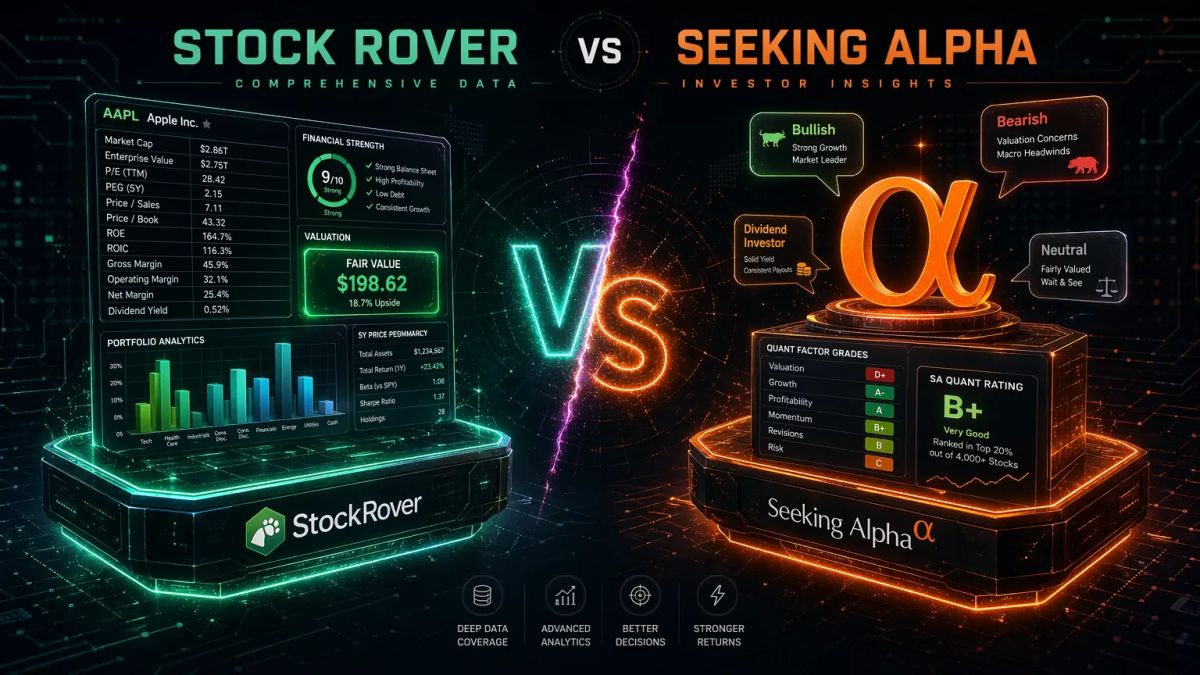
Stock Rover vs Seeking Alpha – Stock Rover comprehensive data and portfolio analytics compared to Seeking Alpha Quant Factor Grades and investor insights for better returnsBoth Stock Rover and Seeking Alpha are built for investors who do their own research rather than follow someone else's stock picks. They both offer screeners, financial data, stock ratings, and portfolio tools. But the way each platform delivers that information is so different that choosing between them largely comes down to how you prefer to research stocks and how much hands-on analysis you are willing to do.
This comparison covers the origins of each platform, their core features, how their rating systems work, what they cost, and which type of investor benefits most from each.
The Basics: Two Very Different Philosophies
Stock Rover was built by two software engineers and long-time investors who were frustrated with fragmented analysis tools. Founded in 2008, the platform is designed for investors who want to do their own deep analysis. It is essentially an advanced spreadsheet pre-populated with comprehensive financial data. If you know exactly what you are looking for — low P/E ratios, high dividend growth, specific profitability thresholds — Stock Rover gives you the power to find it.
Seeking Alpha takes a different approach by combining crowdsourced investment analysis from more than 18,000 contributors with proprietary Quant Ratings. The platform is ideal for investors who value diverse perspectives and want to read detailed investment theses alongside quantitative data.
The core difference, put simply: Stock Rover gives you the data to build your own analysis. Seeking Alpha gives you other people's analysis to inform your decisions.
Stock Research and Data Depth
Both platforms give you access to extremely detailed financial data for thousands of stocks. You can view not only common ratios like price-to-earnings, but also helpful data for building custom valuation models like price-to-sales and price-to-cash flow ratios. You also get access to more than 10 years of historical data from both platforms.
Where they diverge is in what they do with that data. Stock Rover calculates a fair value for each stock, whereas Seeking Alpha does not. In addition, Stock Rover puts all of its data into PDF research reports, which can be great for investors who prefer reading about a stock rather than digging through data tables. Seeking Alpha does not offer similar research reports.
Seeking Alpha's unique contribution is its contributor network. The platform has more than 7,000 contributors, many of whom are stock analysts, financial bloggers, and hedge fund managers. The contributor articles can take many different approaches to analyzing a stock — different valuation models, economic moat analysis, or competitive positioning. Usually, some articles will be bullish and some will be bearish, giving you competing views of the same stock.
Rating Systems Compared
Both platforms use proprietary rating systems, but they work differently.
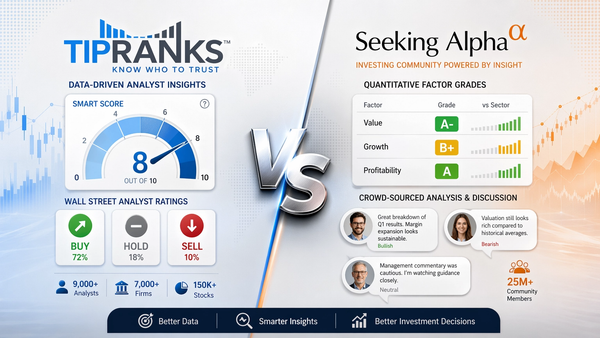
Both platforms rate stocks based on factors like their growth, valuation, and profitability. Stock Rover assigns a 0-100 rating, while Seeking Alpha assigns an A-F rating. You can easily compare stocks against peer companies from within the same industry.
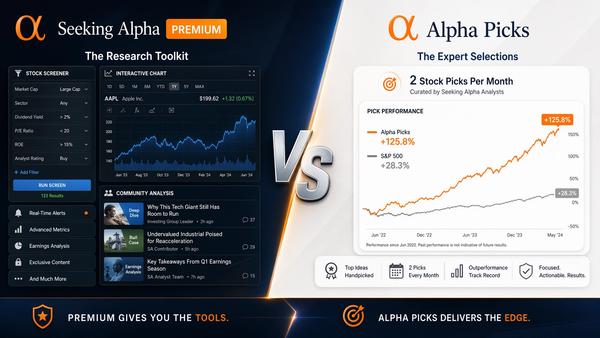
Seeking Alpha's Quant Rating system has a strong documented track record. This system grades every stock daily using over 100 fundamental and technical metrics. Since 2017, the Strong Buy stocks have consistently outperformed both Wall Street analysts and the overall market — in 2024, Quant Strong Buys gained 37.15% compared to just 12.75% for the S&P 500.
Stock Rover calculates its stock ratings based on the past performance of the underlying company relative to its industry group peers. Ratings are calculated across growth, valuation, and financial strength. Metrics that are considered more important are given a higher weight when calculating the overall category rating. Stock Rover also provides different types of scores — value score, growth score, quality, and sentiment — ranging from 0 to 100, computed against the market as a whole rather than peers.
Stock Screeners
Stock Rover and Seeking Alpha both provide outstanding stock screeners that include hundreds of financial, fundamental, and performance metrics. Investors will not find either of these screeners to be lacking in filters and they are both relatively easy to use. One major difference to note is that Stock Rover has more than 150 built-in screens, while Seeking Alpha has around 25. Of course, you can build and save your own custom screens with either platform.
For investors who want pre-built screening strategies to work immediately, Stock Rover's 150-plus ready-made screens give it a clear advantage over Seeking Alpha's smaller library.
Mutual Funds and ETF Coverage
Both Stock Rover and Seeking Alpha cover ETFs in addition to stocks. Seeking Alpha has a dedicated ETF screener, while Stock Rover uses the same screener for stocks and ETFs. Stock Rover also has data for more than 40,000 mutual funds, including Morningstar ratings. Seeking Alpha does not have any mutual fund data.
For investors who hold mutual funds alongside individual stocks, Stock Rover is the only option of the two that covers all bases.
Portfolio Management Tools
Stock Rover offers comprehensive portfolio management tools. You can monitor your portfolio's risk-adjusted return, run correlation analysis, and calculate trades to rebalance your portfolio. Stock Rover also has a useful simulator that lets you predict your future return under different scenarios and analyze the impact of any single trade on your overall performance.
Seeking Alpha lets you create portfolios, but they are much more limited in scope. Essentially, you get a dashboard to view ratings and key financial data for the stocks in your portfolio at a glance. You cannot monitor performance or analyze correlations.
For serious portfolio management with rebalancing tools and scenario modelling, Stock Rover wins outright.
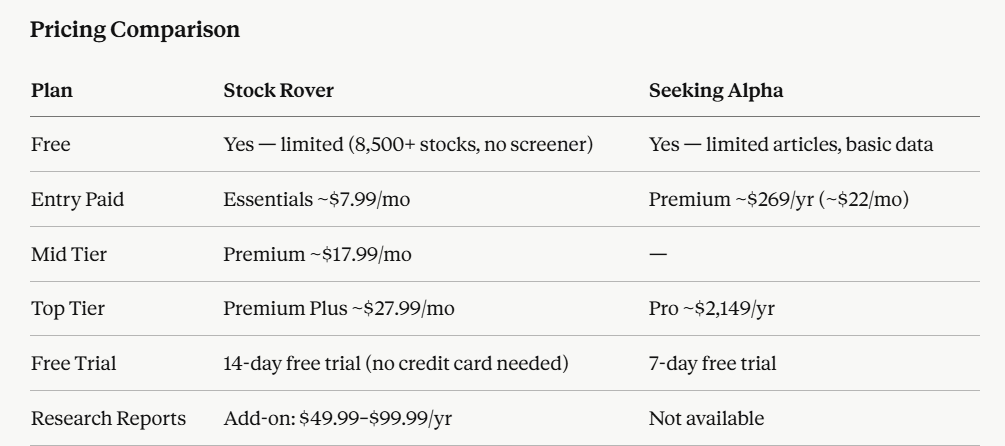
Stock Rover is substantially less expensive than Seeking Alpha, where you must pay at least $299 per year to access the screeners. Seeking Alpha provides more first-hand insights and proprietary research from the investment experts who contribute to its publication. Seeking Alpha also features an active community of investors who share ideas.
People Also Ask
Q: Is Stock Rover better than Seeking Alpha?
It depends on your priorities. Stock Rover is the better choice if you want stock research reports, fair value analysis, or portfolio management tools. It is also better for investors who invest in mutual funds alongside stocks and ETFs. Seeking Alpha is the better choice if you want to know everything there is to know about a stock — the contributor articles are a really unique selling point, and Seeking Alpha can also be good for investors who want a combination of stock picks and research through its top stocks list.
Q: Does Stock Rover have a Quant rating like Seeking Alpha?
Not in the same way. Stock Rover calculates ratings based on the past performance of a company relative to its industry group peers, with metrics in growth, valuation, and financial strength. Seeking Alpha's Quant Rating is derived by comparing over 100 metrics for a stock to the same metrics for other stocks in its sector, and it is updated daily. Both are data-driven, but Seeking Alpha's Quant system has a longer published performance record and has been validated by an independent academic study.
Q: Which platform is better for beginners?
The Stock Rover dashboard may be a bit intimidating for new investors. Overall, Seeking Alpha is preferred for beginner investors and Stock Rover for those with more experience. Seeking Alpha's community articles, readable charts, and straightforward Quant ratings make it more approachable for investors who are still building their knowledge.
Q: Does Stock Rover cover international stocks?
Stock Rover focuses primarily on North American markets for fundamental data, with no support for cryptocurrencies or other asset classes. Seeking Alpha similarly has limited international coverage outside of major US-listed stocks and ADRs, though it does cover cryptos.
Q: Can I track my portfolio on both Stock Rover and Seeking Alpha?
Yes, both platforms offer portfolio tracking. Seeking Alpha shows you the latest stock ratings, upgrades and downgrades, financial ratios, and performance for each stock inside your portfolio. Stock Rover allows you to link your brokerage accounts to sync your latest positions and run more detailed analytics including correlation analysis and rebalancing tools.
Which Platform Should You Choose?
Stock Rover is the better pick for experienced, data-driven investors who want deep fundamental screening, fair value calculations, mutual fund coverage, and serious portfolio management tools — all at a lower entry price than Seeking Alpha.
Seeking Alpha is the better pick for investors who want to read detailed analysis from multiple perspectives, benefit from a proven Quant rating system with a documented track record, and access a top stocks list that blends quantitative and analyst-driven signals.
Stock Rover is ideal for experienced investors who are already comfortable with market analytics and want to customize reports for a deep dive into their investments. Seeking Alpha is best suited for beginner and intermediate investors who may need a hand understanding market metrics and want to benefit from the community aspect of the platform.
Many investors who use both platforms find them complementary: Stock Rover for the raw data and screening, Seeking Alpha for the narrative and analysis behind a stock they have already identified.