MarketWatch vs Seeking Alpha: The Ultimate Guide
MarketWatch vs Seeking Alpha – MarketWatch delivers free real-time news and market data while Seeking Alpha offers deep research and expert insights. Compare now.


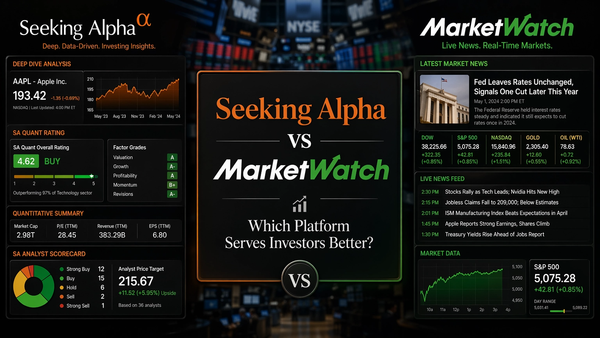
MarketWatch vs Seeking Alpha ultimate guide – MarketWatch real-time market data and breaking news compared to Seeking Alpha in-depth research and expert insightsTwo platforms come up constantly in conversations about online financial research: MarketWatch and Seeking Alpha. Both have loyal user bases, both cover the stock market extensively, and both are free to start. Yet they serve very different needs. Picking the wrong one does not mean getting bad information — it means spending time in the wrong place for what you actually want to do.
Here is a plain, honest breakdown.
What Is MarketWatch?
MarketWatch is a financial news and analysis website that was founded in 1997. It is owned by Dow Jones & Company, a division of News Corp, which also owns The Wall Street Journal and Barron's. It attracts over 20 million visitors each month and is committed to breaking news coverage, real-time financial data, and thorough market assessments.
MarketWatch is, at its core, a news organization. Its journalists produce market updates, economic reports, and personal finance articles throughout the trading day. The platform includes a market data center that tracks index fluctuations, stock prices, and other securities in real time, along with advanced charting tools through BigCharts and customizable quote tracking.
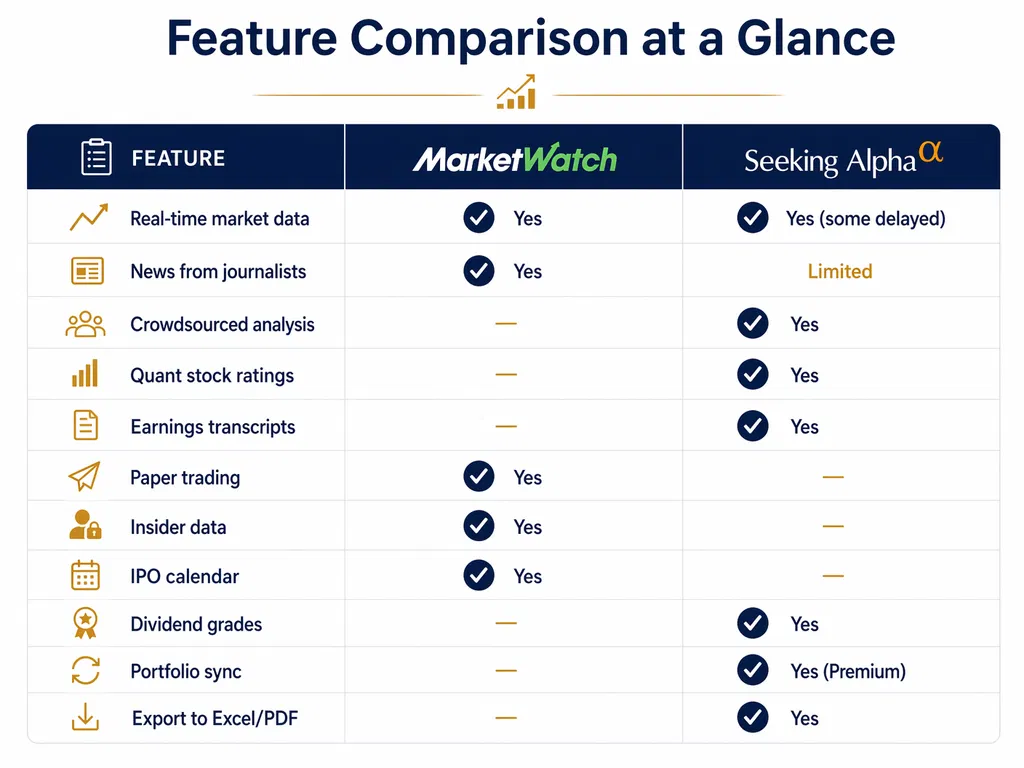
MarketWatch also covers categories that Seeking Alpha skips, including paper trading, insider data, short interest, interest rates, yield curves, IPO schedules, and newsletters.
What Is Seeking Alpha?
Seeking Alpha was founded in 2004 by David Jackson, a former Morgan Stanley technology analyst. It operates as an investment community that uses a crowdsourced model for investment research, opinions, and analysis.
The platform covers 8,000 to 10,000 tickers per quarter, compared to the few hundred that most sell-side firms cover. Contributors include independent analysts, portfolio managers, and active investors who publish their own research. Editors review submissions before publication.
Seeking Alpha is known for its Quant Ratings, which grade stocks across five factor grades: Value, Growth, Profitability, Momentum, and EPS Revisions. It also offers ETF factor grades and side-by-side stock comparison tools with Excel and PDF export.
A 2024 study by professors at the University of Kentucky found that Seeking Alpha's Quant Ratings strongly predict future returns and offer pronounced benefits to investors who follow them.
Q: What is the main difference between MarketWatch and Seeking Alpha?
The core distinction is purpose. MarketWatch is primarily a news website that delivers the latest stock market, financial, and business news, while Seeking Alpha is primarily focused on helping investors discover new investment ideas and make better decisions through proprietary stock ratings and crowd-sourced analysis.
MarketWatch tells you what is happening right now. Seeking Alpha helps you decide what to do about it.
Q: Is Seeking Alpha free or does it require a subscription?
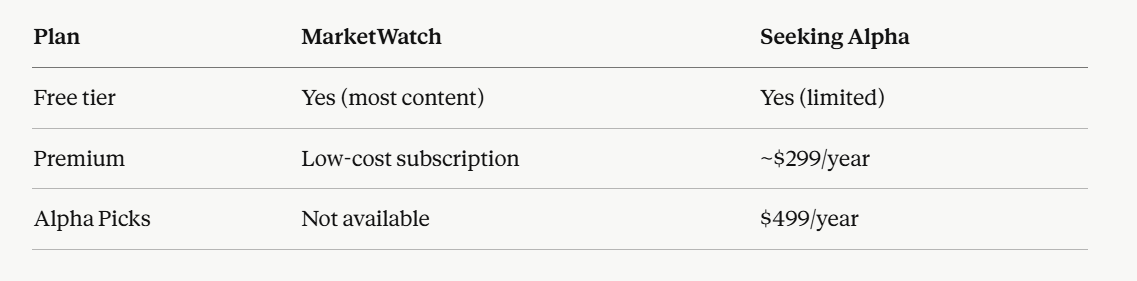
MarketWatch is largely free, with no subscription fees required to access most of its content. Seeking Alpha offers a mix of free and paid content. The free tier on Seeking Alpha gives limited article access each month before hitting a paywall. Premium starts at around $29.99 per month or $299 per year.
Q: Which platform is better for beginners?
Beginner investors may not be comfortable digging through a high volume of research and analysis, particularly if they are not knowledgeable about stock metrics and how to read financial statements. For that reason, these investors may prefer MarketWatch, which offers research tools mostly linked to market news rather than deep dives into individual company financials.
Seeking Alpha has a steeper learning curve. Its tools assume the user already understands basic financial terms like P/E ratios, EPS revisions, and dividend yields. For someone who is still figuring out how stocks work, MarketWatch is the more approachable starting point.
Q: Which platform is better for serious or experienced investors?
Experienced and intermediate investors, as well as portfolio managers and serious traders, are more likely to prefer Seeking Alpha. It offers 10 years of financials for publicly traded companies, plus a large library of analysis from both investment experts and community members, along with Quant ratings and advanced screening and portfolio management tools.
Seeking Alpha's portfolio tools include custom views, health scores, and Excel export. Premium users can link brokers for daily auto-sync through Plaid or SnapTrade.
Q: Can you use both MarketWatch and Seeking Alpha together?
Yes, and many investors do. The two platforms are not competitors in practice — they fill different gaps. MarketWatch handles the daily news flow, economic data, and macro context. Seeking Alpha handles the deeper research: reading analyst opinions, reviewing a company's five-year financials, checking its Quant rating, and browsing earnings call transcripts.
Seeking Alpha has established distribution partnerships with MarketWatch, CNBC, MSN, NASDAQ, and TheStreet.com, so the two platforms are already connected in the financial media ecosystem.
Which One Should You Pick?
The answer depends on what you are trying to accomplish.
If you want to follow markets daily, stay current on economic news, and track a watchlist without paying anything, MarketWatch gets the job done without asking for a credit card.
If you want to research specific stocks before buying, compare companies side by side, track a portfolio with real performance data, or access analyst-written deep dives on companies that Wall Street rarely covers, Seeking Alpha is the stronger tool — particularly once you move past the free tier.
Seeking Alpha holds a 4.0 out of 5 score on Trustpilot based on user reviews, while MarketWatch carries a 1.4 out of 5 score. That gap partly reflects the different expectations users bring to each platform. News sites tend to attract more complaints than research tools.
The simplest rule: use MarketWatch when you want to know what is going on. Use Seeking Alpha when you want to know what it means for your portfolio.