Motley Fool vs Zacks vs Seeking Alpha: Honest Breakdown
Motley Fool vs Zacks vs Seeking Alpha – Motley Fool gives stock picks, Zacks offers quant rankings and Seeking Alpha delivers expert research. Find your best fit.

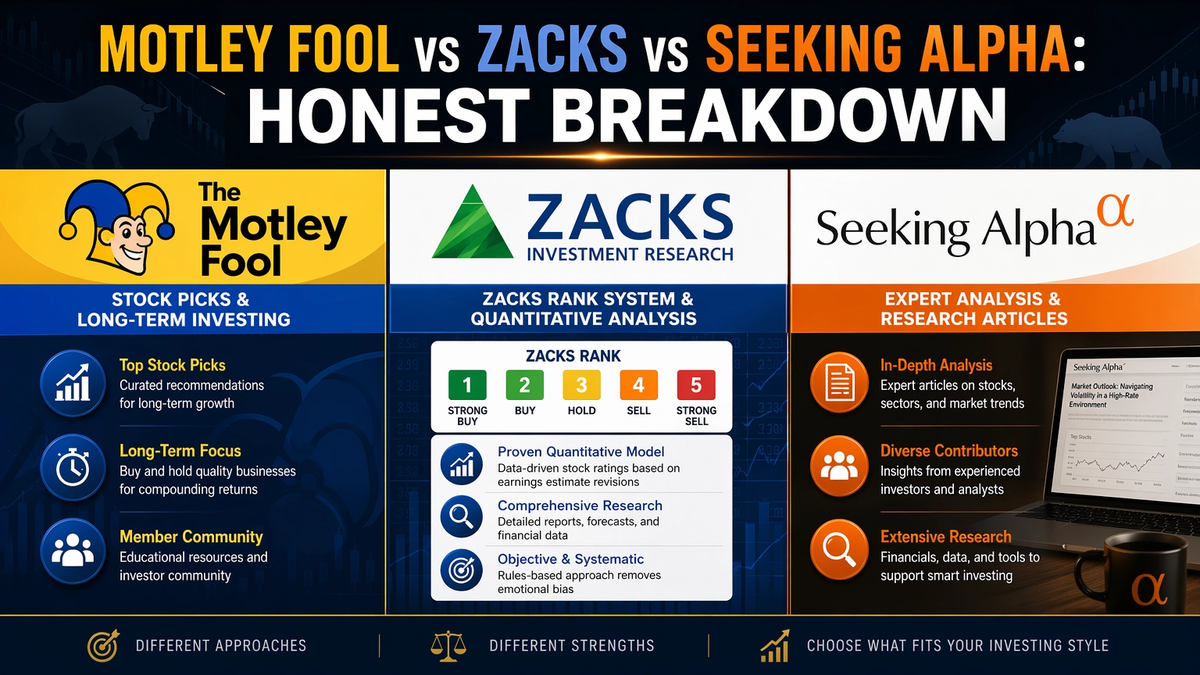
Motley Fool vs Zacks vs Seeking Alpha honest breakdown – Motley Fool stock picks, Zacks Rank quantitative analysis and Seeking Alpha expert research articles comparedChoosing an investment research platform is not a trivial decision. The one you pick shapes how you find stocks, how you evaluate them, and ultimately how your portfolio performs. Motley Fool, Zacks, and Seeking Alpha are three of the most widely used services in this space, yet they are built on completely different philosophies. Understanding what each one does — and who it is actually designed for — makes the choice far simpler than most comparison articles suggest.
What Is Each Platform, Really?
Seeking Alpha is an investment research website that provides fundamental data, news, stock screeners, portfolio tools, and a quantitative stock grading system — all the tools necessary for investors to perform their own due diligence. It is best known for its contributor model: Seeking Alpha's service is fueled by more than 7,000 contributors who produce research, making it one of the most popular stock research websites in the world with more than 20 million visits per month.
The Motley Fool is a financial services and media company that was founded in 1993 by brothers Tom and David Gardner. While Seeking Alpha primarily provides the tools and information you need to perform your own investment research, The Motley Fool does the investment research for you via its stock-recommendation services.
Zacks Investment Research was founded in 1978 by MIT researcher Len Zacks. After spending years analyzing stocks, Len made an observation: earnings estimate revisions may be the most powerful force impacting stock prices. That single observation became the backbone of the entire Zacks system, which has not changed substantially in its logic since.
Frequently Asked Questions
Q: Which is better for beginners — Motley Fool, Zacks, or Seeking Alpha?
Motley Fool is the best choice for beginners. The recommended buy-and-hold strategy is easy to follow, and there is plenty of simple and easy-to-understand investment advice, plus monthly picks and newsletters. The done-for-you picks make it easy to build a portfolio and get your feet wet as an investor.
Q: Is Seeking Alpha better than Zacks?
Seeking Alpha is a better service than Zacks. Zacks remains very surface-level, while Seeking Alpha offers in-depth research analysis performed by many highly-educated investors which you can use to guide your own investment decisions. There is also a practical reason to lean toward Seeking Alpha: Seeking Alpha shows analysts' estimate revisions alongside all of its other data points, so a subscription to Seeking Alpha also includes the Zacks Rank system. You do not actually need Zacks Premium — you can look up an unlimited number of stocks on Zacks and get their Zacks Rank without paying.
Q: What is the Zacks Rank system and how does it work?
The Zacks Rank is calculated from four inputs: Agreement (the percentage of analysts revising estimates higher), Magnitude (the size of the change), Upside (the gap between the most accurate estimate and consensus), and Surprise (companies with historical positive earnings surprises are more likely to surprise again). These components are recalculated every night.
Q: How has Motley Fool Stock Advisor performed compared to the S&P 500?
After analyzing 504 picks across 23.9 years, Stock Advisor has delivered +883.8% total returns since inception in March 2002, versus +195.8% for the S&P 500 over the same period. The service has a 65% overall win rate, with 182 stocks that doubled and 42 ten-baggers. That said, the cumulative return figures reflect every pick since 2002, including early recommendations in companies like Amazon, Netflix, and Nvidia that delivered extraordinary returns. A meaningful percentage of Stock Advisor picks have underperformed the market, and the service's overall outperformance is driven by a relatively small number of massive winners.
Q: Can I use Seeking Alpha and Motley Fool at the same time?
Yes, but it is important to make sure you are not spending more than you can afford — or more than you are earning from your investments. If you want Motley Fool's picks but also want access to in-depth research, you might benefit from two subscriptions. In practice, many investors use Motley Fool to identify stocks and Seeking Alpha Premium to conduct further due diligence before pulling the trigger.
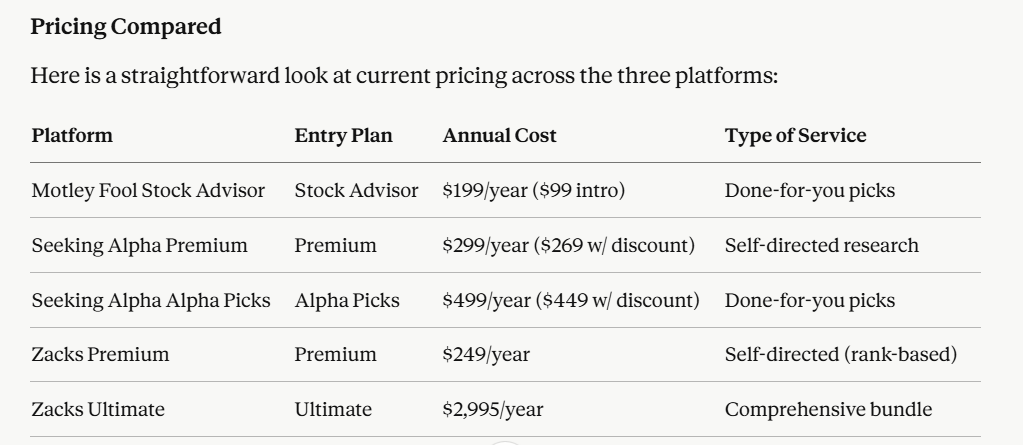
Zacks Ultimate, despite claiming similar performance to competitors, is significantly more expensive at $2,995 annually, raising questions about value for cost-conscious investors.
Who Each Platform Is Actually Built For
The clearest way to think about these three services is by investor type, not by feature list.
Motley Fool is for investors who want someone else to do the heavy lifting. Stock Advisor makes sense for people who want guidance without overcomplication. It is not built for short-term moves or constant activity. Instead, it rewards patience, consistency, and a willingness to think in years rather than weeks.
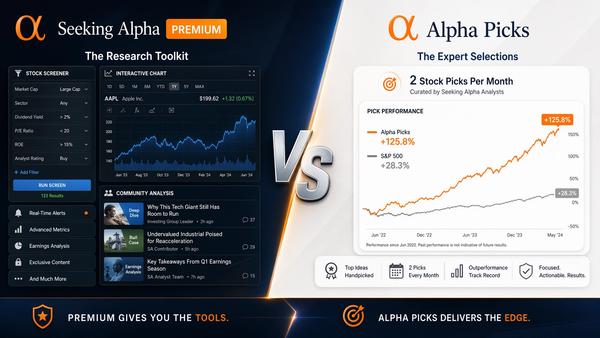
Seeking Alpha is for investors who enjoy the research process. Seeking Alpha Premium unlocks the platform's full research capabilities. The standout feature is the Quant Rating system, which evaluates thousands of stocks across five factors: Value, Growth, Profitability, Momentum, and EPS Revisions. Each stock receives a rating from Strong Buy to Strong Sell based on quantitative analysis.
Zacks is for investors who are specifically interested in earnings-driven, shorter-term momentum signals. Zacks Investment Research focuses on earnings estimate revisions and stock rankings, making it ideal for short-term traders looking for momentum plays. If you prioritize earnings-driven stock picks and data-backed rankings, Zacks is the better choice, while Seeking Alpha is stronger for fundamental analysis and expert commentary.
Performance: What the Track Records Actually Show
Independent testing of top stock-picking services reveals that Seeking Alpha's Alpha Picks leads with an impressive 53% annualized return, significantly outpacing its competitors. The Motley Fool's Stock Advisor comes in second with a solid 24% annual return. Both offer clear and audited recommendations that beat the market.
Seeking Alpha's Alpha Picks is beating the S&P 500 by 47% across 64 stock picks over the last three years, making it the top performer among the services tracked by independent subscribers who follow multiple newsletters simultaneously.
For Motley Fool, every year of stock picks for the last 10 years were profitable and are beating the market on average by 33%. Over the last 10 years, the average pick is up 122% and the market on average over that time is up 111%.
Zacks Rank #1 stocks have had an average return of 24.9% per year over more than 34 years, more than double the S&P 500 average of 10.9%. However, individual subscriber results depend heavily on how strictly the system is followed and when positions are entered.
The Bottom Line
There is no single winner in the Motley Fool vs Zacks vs Seeking Alpha debate because the three services are not competing for the same investor. They serve different needs at different price points.
If you are new to investing and want straightforward stock recommendations with a long track record, Motley Fool Stock Advisor at $199 per year is a sensible starting point. If you are an experienced investor who wants deep research tools, a quant rating system, and thousands of analyst articles, Seeking Alpha Premium gives you more for the money. If you are specifically drawn to the earnings-revision approach and want a ranked list of momentum stocks, Zacks Premium has its audience — but most of what it offers is already available within Seeking Alpha at no additional cost.
The most important filter is self-awareness: know whether you want someone to pick stocks for you, or whether you want the tools to make those decisions yourself. That single question will eliminate two of the three options before you spend a dollar.