Seeking Alpha vs Morningstar: Which Investment Research Platform Should You Use?
Seeking Alpha vs Morningstar — compare features, pricing, and research tools. Find out which platform suits your investment style best.

Seeking Alpha vs Morningstar comparison – Seeking Alpha offers investor community and market insights while Morningstar provides independent research and timely ratings for better investingIf you have spent any time researching stocks on your own, you have almost certainly come across both Seeking Alpha and Morningstar. They are two of the most recognized names in retail investment research, and at first glance they seem to offer similar things: stock data, ratings, analysis, and portfolio tools. But once you dig into how each platform actually works, the differences become clear — and those differences matter quite a bit depending on what kind of investor you are.
This comparison breaks down both platforms across the areas that count most: research quality, data coverage, ratings systems, portfolio tools, and pricing.
What Is Seeking Alpha?
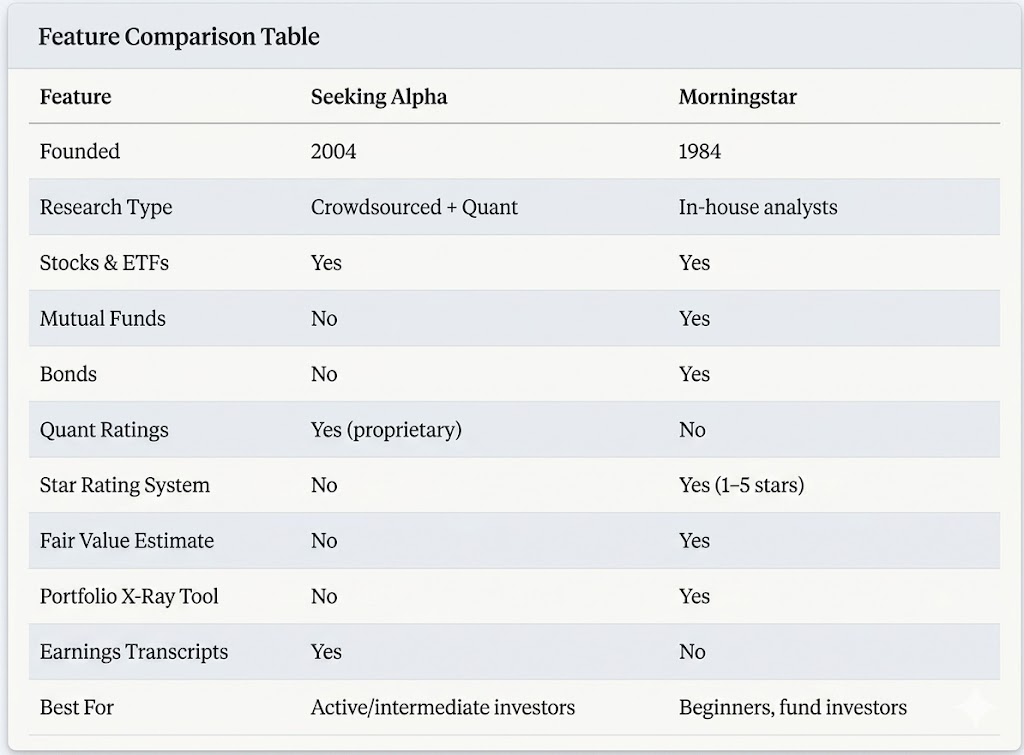
Seeking Alpha is a stock research platform founded in 2004 by David Jackson, a former research analyst for Morgan Stanley. It stands out for its crowdsourced analysis articles, written by professional stock analysts, hedge fund managers, financial bloggers, and others. The platform covers stocks and ETFs.
It blends professional insights with crowd-sourced ideas. You will find in-depth stock analysis, earnings call transcripts, macroeconomic commentary, and tools that let you filter through thousands of securities. It is a popular choice for DIY investors who want to consider a wider range of opinions before making a decision.
One of its most talked-about features is the Quant Ratings system. Quant Ratings are Seeking Alpha's proprietary ratings, based on an investment's value, growth, profitability, EPS revisions, and price momentum. Investments that have received a "Strong Buy" rating have outperformed the S&P 500 by almost 7x.
What Is Morningstar?
Morningstar is an investment research platform that has been around since 1984. The firm has a large in-house team of analysts who cover stocks, ETFs, mutual funds, and bonds. Morningstar offers detailed fundamental research as well as tools to help you manage your portfolio.
All of Morningstar's analysis is written in-house by its team of professionals. As such, it caters to a slightly more sophisticated investor and is frequently used by financial advisors and other professionals. Morningstar has an excellent reputation in the investment industry and provides the most value for free among major platforms, especially for researching ETFs and mutual funds.
People Also Ask
Q1: Is Seeking Alpha better than Morningstar?
It depends on your investing style. If you are looking for objective analysis and ratings on stocks, ETFs, and mutual funds, Morningstar is the better choice. Seeking Alpha's analysis is subjective, opinionated, and crowdsourced from thousands of contributors. On the other hand, if you prefer active research with multiple viewpoints and quantitative grading tools, Seeking Alpha gives you more volume and flexibility. Neither platform is universally better — they serve different purposes.
Q2: Which platform is better for mutual funds?
Seeking Alpha works better if you are primarily a stock investor. But if you are a mutual funds investor, Morningstar is the stronger choice. Morningstar Investor's specialty lies in mutual funds, even though it also offers stock analysis. It is a good option if you plan to build a portfolio that includes mutual funds alongside stocks and ETFs, and you will get a more structured portfolio analysis report
Q3: What type of investor is each platform best for?
Seeking Alpha appeals to those looking for in-depth market analysis and unique research, making it better suited for intermediate to advanced investors. Morningstar is preferred by beginners or those needing solid intermediate-level guidance.
Q4: How do the ratings systems compare?
Seeking Alpha Premium offers three types of stock ratings: from Seeking Alpha authors, Wall Street analysts, and its objective Quant system. These indicate whether a particular stock is a good buy or sell. Morningstar, by contrast, is known for its star rating system, with 5-star stocks representing the platform's top analyst-rated picks.
Q5: Can you use both Seeking Alpha and Morningstar together?
Yes, and many serious investors do. The platforms complement each other well. Morningstar covers mutual funds and bonds that Seeking Alpha does not, while Seeking Alpha offers community-driven insights and Quant Ratings that Morningstar lacks. Using both gives you broader coverage and lets you cross-check conclusions before making decisions.
Research Quality: Community vs. In-House Analysts
This is the core difference between the two platforms.
The best part of Seeking Alpha's research is the articles written by contributors. There are typically multiple recent analysis articles for popular stocks, and each one takes a different approach to analyzing a stock's value. This means you can read a bull case and a bear case on the same company within minutes, which is genuinely useful when forming your own view.
Morningstar offers a research report for each stock or fund written by one of the firm's analysts. These reports are more beginner-friendly than contributor articles on Seeking Alpha, which can be very technical. The reports tend to be balanced, covering valuation modeling, market trends, and company leadership, and they deliver a firm conclusion that clearly advises whether or not you should consider adding a stock to your portfolio.
The tradeoff is clear. Seeking Alpha gives you volume and perspective. Morningstar gives you consistency and a clear verdict.
Portfolio Tools
Morningstar's portfolio management tools are a highlight of the platform. If you own a mix of stocks, ETFs, and mutual funds, Morningstar will break down those funds into their individual components to give you an in-depth view of your holdings. The Portfolio X-Ray tool is particularly useful — it shows you sector concentration, geographic exposure, and overlapping holdings across funds.
Seeking Alpha's portfolio tools are more basic by comparison, though it has recently added Portfolio Health Scores. The platform is better suited to research than portfolio management.
Pricing
Both platforms offer free access with limited features. Paid plans vary as follows:
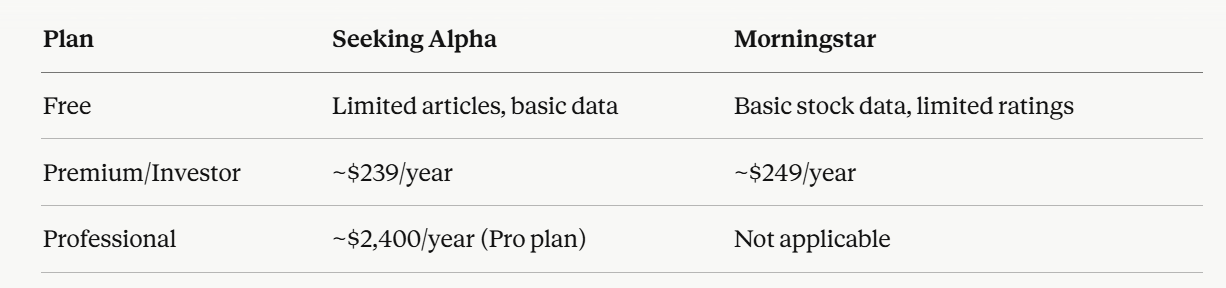
Pricing is comparable at the core subscription level. Seeking Alpha offers a 7-day free trial with its Premium plan, which gives you full access before committing to the annual subscription. Morningstar Investor also offers a trial period.
Which One Should You Choose?
The right answer depends on what you are trying to do.
Choose Seeking Alpha if you research individual stocks and ETFs regularly, want multiple analyst perspectives on the same company, value earnings transcripts and a community forum, and want a Quant-based rating system that has a measurable track record against the S&P 500.
Choose Morningstar if you invest in mutual funds or bonds in addition to stocks, prefer clean and structured analysis from credentialed analysts, want a straightforward fair value estimate on every stock, and need solid portfolio management tools like the X-Ray feature.
Comparing Morningstar and Seeking Alpha, Seeking Alpha's most unique features are its investment community and Quant ratings, while Morningstar offers research on some investments that Seeking Alpha does not — particularly mutual funds and bonds.
For many investors, the real question is not which platform to pick but which one fits their current needs. A dividend-focused long-term investor building a fund-heavy retirement portfolio will get more from Morningstar. A stock picker who reads several analysis pieces before pulling the trigger will likely find Seeking Alpha more valuable day to day. Neither platform does everything, but together they cover most of what a self-directed investor needs.
Bottom Line
Seeking Alpha and Morningstar have both earned their reputations, but they earn them differently. Morningstar is the more structured, institution-grade platform with broader asset class coverage. Seeking Alpha is the more active, research-dense platform for investors who want to form their own views from a wide range of sources. The choice comes down to your investment style, asset mix, and how much weight you put on community opinion versus professional analysis.