Seeking Alpha vs Yahoo Finance: Which Platform Gives You the Better Edge?
Seeking Alpha vs Yahoo Finance – Seeking Alpha offers premium research and Quant Ratings while Yahoo Finance provides free market data and news. See which wins.

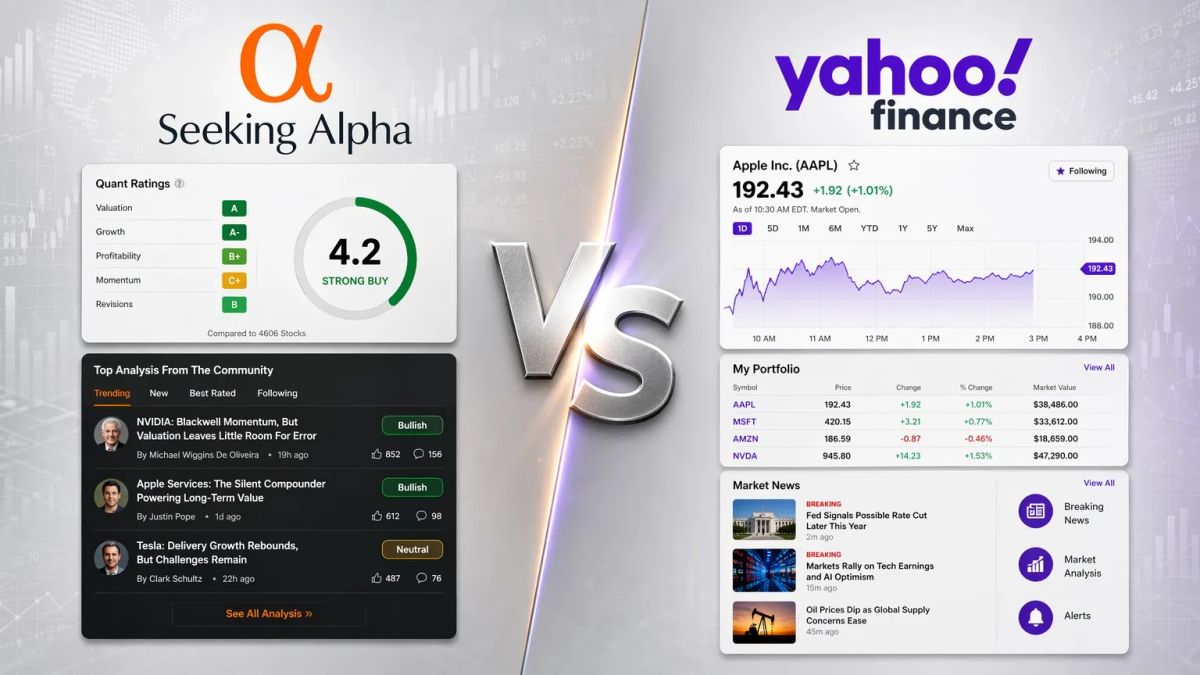
Seeking Alpha vs Yahoo Finance – Seeking Alpha Quant Ratings with Strong Buy scores versus Yahoo Finance real-time stock data, portfolio tracking and market newsIf you track stocks regularly, you have almost certainly used Yahoo Finance. It has been around since 1997 and remains one of the most visited financial websites in the world. Seeking Alpha, launched in 2004, targets a more research-oriented audience and sits firmly behind a paywall for most of its best features. Both platforms cover stocks, ETFs, and market news — but they are built for different purposes and serve different types of investors.
This article walks through every meaningful difference between the two, including pricing, research depth, stock screeners, and which platform makes more sense depending on how you invest.
Background: Who Are They?
Seeking Alpha is an online investing community founded in 2004 that now has more than 20 million active users. It focuses on stocks and ETFs and offers access to extremely detailed fundamental research and screeners. Seeking Alpha is perhaps best known for its research articles, which are contributed by thousands of financial professionals including analysts and fund managers.
Yahoo Finance was launched in 1997, making it one of the oldest online hubs for stock research. The platform has more than 90 million monthly users in the US alone and is renowned for the free data it provides about stocks, ETFs, mutual funds, and bonds.
The scale gap tells a story. Yahoo Finance reaches a far larger general audience because it is free and familiar. Seeking Alpha draws a smaller but more focused group of investors who are willing to pay for deeper research tools.
What You Get for Free
The free plans at Seeking Alpha and Yahoo Finance have a lot in common. Both provide access to detailed fundamental research and financial data for thousands of stocks. You can pull up balance sheets, view Wall Street analysts' ratings, and read brief news articles relevant to each stock. You can also build custom watchlists to monitor your favorite stocks with a free account on either platform.
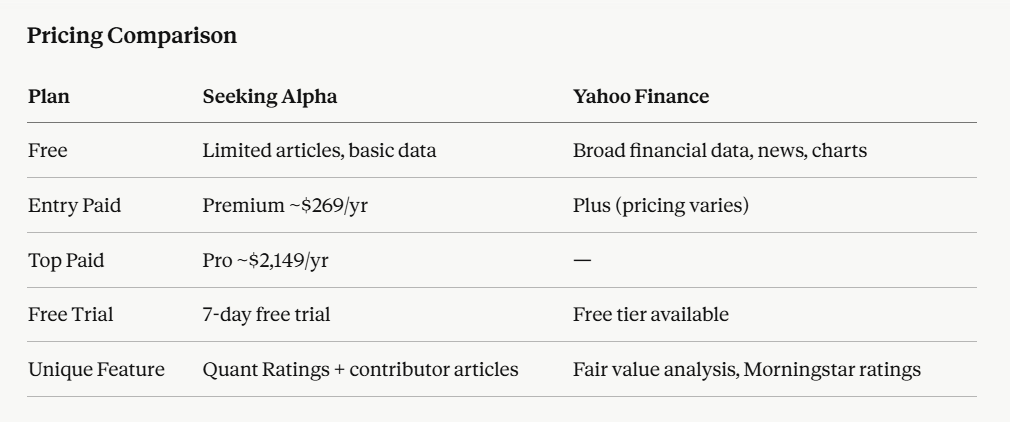
The key difference is what sits behind the free tier. Most of the data Yahoo Finance offers is available with a free account. On the other hand, most of the data Seeking Alpha offers requires a paid subscription. So if your goal is free access to financial data, Yahoo Finance wins by a significant margin.
Research Depth
This is where the two platforms separate most clearly.
Seeking Alpha excels at diving deep into each stock and providing actionable analysis. The platform provides nearly 20 valuation metrics, for example, and rates each company on each metric on an A-F scale based on how it compares to peers. There are nearly as many metrics — each with their own A-F ratings — for growth, momentum, and profitability.
Yahoo Finance, in contrast, offers only a few common financial metrics like price-to-earnings and price-to-sales. There is no peer analysis or ratings similar to those in Seeking Alpha. However, Yahoo Finance does offer fair value analysis with a Plus subscription, which Seeking Alpha does not include.
For contributor research, Seeking Alpha offers something Yahoo Finance simply cannot match. Seeking Alpha is a treasure trove of insights with an exceptionally active user base, and it provides extensive coverage of dividends, earnings, and macro factors. The ratings on the platform leverage both breadth — an aggregate of Seeking Alpha, wider Wall Street, and quantitative analysis — and depth, utilizing profitability, growth, momentum, valuation, and rating revisions.
Seeking Alpha offers crowdsourced analysis, Quant ratings, cash flow statements, and earnings call transcripts, which Yahoo Finance does not. Yahoo Finance focuses on general news and charts. That is why Seeking Alpha is more useful for investors who want research depth.
Stock Rating Systems
Both platforms rate stocks, but the methodology is very different.
Seeking Alpha uses a quantitative model that rates stocks on a scale from 1–5, with factor ratings for value, growth, and momentum. It also provides another 1–5 rating based on what Seeking Alpha analysts think about a stock. Yahoo Finance provides a stock score on a scale from 0–100 that is based on fair value analysis, dividends, innovation, hiring trends, and insider sentiment.
The Seeking Alpha Quant system has a documented track record. Strong Buy selections have outperformed the S&P 500 consistently going back to 2010. Conversely, stocks rated Strong Sell have consistently underperformed the market. Yahoo Finance does not publish equivalent backtested performance data for its stock scoring system.
Stock Screeners
Seeking Alpha has advanced screeners with hundreds of options to get the exact data you need. By contrast, Yahoo Finance's screeners are much simpler and offer fewer filtering options.
With the Seeking Alpha stock screener, you can filter stocks based on any of the available ratings or valuation, growth, profitability, and momentum metrics. You can also filter based on standard fundamental metrics or financial statement metrics. Having the ability to filter based on ratings is particularly valuable, since you can limit your search to stocks that are highly rated by Seeking Alpha's quantitative model or analysts.
Yahoo Finance's screener allows filtering by basic fundamental metrics and includes some fair-value-based filters, but it does not let you screen by proprietary rating grades the way Seeking Alpha does.
Asset Class Coverage
Both platforms cover stocks, ETFs, mutual funds, commodities, and cryptocurrencies. Yahoo Finance adds coverage for options, futures, and currencies. For traders who need to monitor derivatives and currency markets in one place, Yahoo Finance has broader coverage at the asset class level.
People Also Ask
Q: Is Seeking Alpha better than Yahoo Finance?
It depends on what you need. Yahoo Finance offers robust financial news and data, serving as a free alternative for market analysis and insights. While it lacks Seeking Alpha's in-depth analysis tools, it provides valuable information for investors at no cost. Seeking Alpha is the stronger tool for investors who want deep research, multiple analyst perspectives, and a proven stock rating system — but you pay for that access.
Q: Is Yahoo Finance free to use?
Yes. Most of the data Yahoo Finance offers is available with a free account. The platform has a Plus subscription that adds fair value analysis and Morningstar ratings, but the core features — stock quotes, financial statements, news, watchlists, and basic screeners — are all free.
Q: Does Seeking Alpha have a free plan?
Seeking Alpha offers a free version that includes unlimited access to news, a single premium article, and real-time stock prices. The Quant ratings, full stock screener, contributor article library, portfolio health tools, and brokerage sync are all restricted to the Premium plan.
Q: What asset classes do Seeking Alpha and Yahoo Finance cover?
Both platforms cover stocks, ETFs, mutual funds, commodities, and cryptocurrencies. Yahoo Finance adds coverage for options, futures, and currencies. Seeking Alpha is more focused on stocks and ETFs, while Yahoo Finance offers broader asset class coverage at a surface level.
Q: Can I track my portfolio on both Seeking Alpha and Yahoo Finance?
Both platforms include portfolio tracking, so you can monitor your holdings, performance, and allocation in one place. Both also allow data export to spreadsheets for custom analysis or record-keeping. Seeking Alpha additionally allows you to sync an external brokerage account directly and receive alerts when the Quant Rating changes on any stock you hold — a feature Yahoo Finance does not offer.
Which Platform Is Right for You?
Yahoo Finance is the right starting point for any investor who wants free, reliable market data, broad news coverage, and a simple portfolio tracker. It covers a wider range of asset classes, has no paywall for core features, and works well for casual monitoring of stocks and market trends.
Seeking Alpha is the better platform for investors who do their own research, want multiple analyst perspectives on a single stock, and are willing to pay for a rating system that has a documented history of outperforming the market. Yahoo Finance is like that reliable friend who always has the latest news at their fingertips, while Seeking Alpha feels more like an exclusive club where seasoned investors gather to share deep dives into specific stocks and sectors.
For most active investors, the two platforms are not really competing. Many use Yahoo Finance daily for news and quick data checks, then turn to Seeking Alpha when they want to research a stock in depth before making a decision. Used together, they cover most of what a self-directed investor needs.