Seeking Alpha vs Zacks: Which Stock Research Platform Is Worth Your Money?
Seeking Alpha vs Zacks – Seeking Alpha offers community insights and Quant Ratings while Zacks provides earnings-based stock rankings. Find the best pick for you.

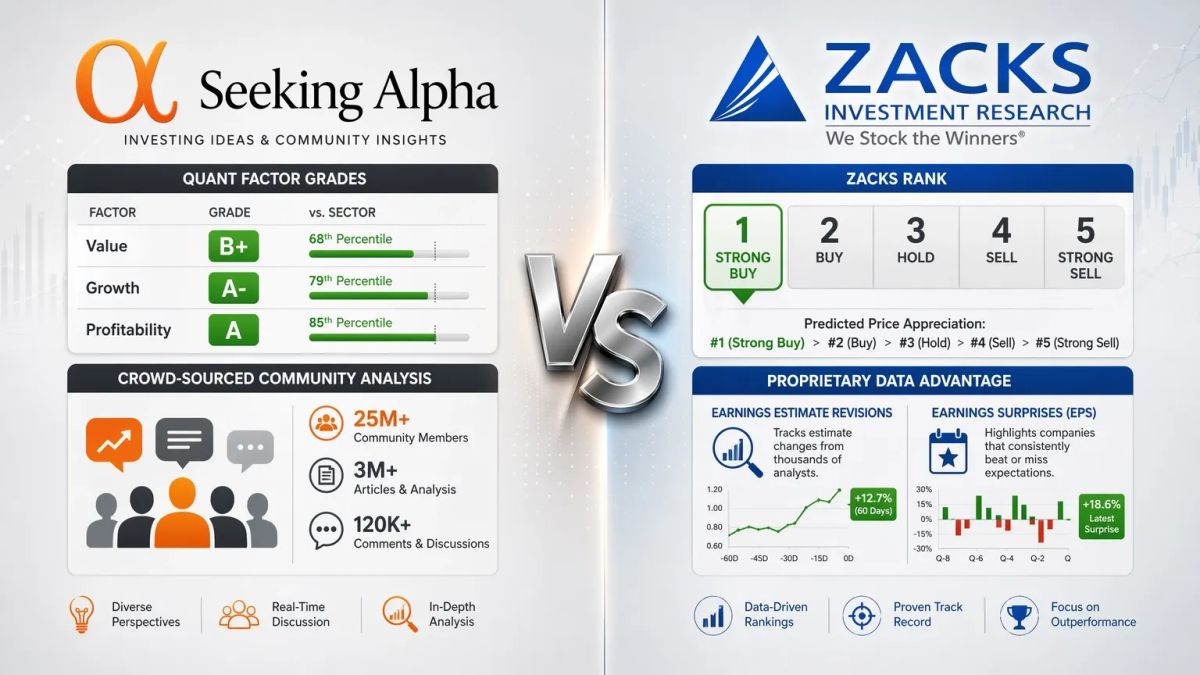
Seeking Alpha vs Zacks – Seeking Alpha quant factor grades and 25M community insights compared to Zacks Rank system with earnings estimate revisions and EPS dataSeeking Alpha and Zacks are two of the most recognized names in independent stock research. Both have been around for decades, both use proprietary rating systems to help investors find strong stocks, and both offer free and paid tiers. Yet they are built on fundamentally different philosophies — and that difference matters when you are deciding where to spend your research budget.
This article covers the origins of each platform, how their rating systems work, what you get for the price, and which type of investor is best served by each.
The Origins: Two Very Different Starting Points
Zacks was started by Len Zacks in 1978, a PhD from MIT. Len was obsessed with analyzing Wall Street analysts and wanted to build his own team of in-house analysts. Zacks believes that earnings estimate revisions are the most powerful factor to drive stock prices.
Seeking Alpha was started in 2004 by financial analyst David Jackson. The original plan was to create a research platform where passionate investors can share their own stock analysis with a community. A big component of Seeking Alpha is the idea of crowdsourcing investing — sharing knowledge with a community and all supplying, refining research, insights, and opinions. Instead of having its own analysts, Seeking Alpha uses Wall Street analysts, individual investors, fund managers, and other reputable market watchers.
This difference in origin still defines how each platform works today.
How the Rating Systems Work
Zacks runs on one central idea. When Wall Street analysts adjusted their earnings estimates, stock prices tended to follow in the near- to medium-term. Every stock Zacks covers receives a rank from 1 (strong buy) to 5 (strong sell). The #1 rank list typically contains more than 200 stocks at any given time and updates frequently.
At Zacks, each stock's value, growth, and momentum are also rated on an A-F scale. In addition, you can pull up interactive charts of a company's key fundamental metrics and see how a stock's valuation has responded to recent earnings reports.
Seeking Alpha's approach is broader. One of Seeking Alpha's most powerful features is their Quant Rating on each stock. This system grades every stock daily using over 100 fundamental and technical metrics. Since 2017, the "Strong Buy" stocks have consistently outperformed both Wall Street analysts and the overall market — in 2024, Quant Strong Buys gained 37.15%, compared to just 12.75% for the S&P 500.
Seeking Alpha also has earnings estimate revisions — which is what Zacks is built on — and so much more. In other words, the Zacks Rank data point is already built into Seeking Alpha's broader Quant system.
Research Depth: Articles vs. Reports
This is where the two platforms feel most different day to day.
At Zacks, you will find an in-depth research report for every stock the company covers. These are traditional equity research reports written by in-house analysts tasked with covering a specific set of stocks.
Seeking Alpha takes a slightly different approach. Instead of having a single analyst write a research report, Seeking Alpha accepts op-ed style analysis articles from a wide variety of professional investors and analysts. For any given stock, you can find five to ten recent analysis articles. These articles may offer differing opinions or use different approaches to gauge a stock's value or growth potential.
The trade-off is clear. Zacks gives you one clean, professional view of a company. Seeking Alpha gives you a range of perspectives — bull cases, bear cases, valuation models, and industry analysis — but you have to do more reading to form your own conclusion.
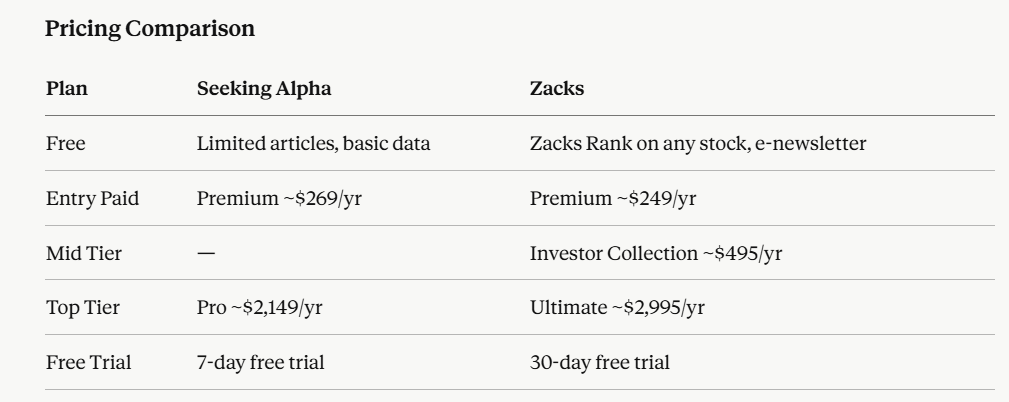
Both platforms operate on freemium models, meaning a meaningful amount of data is available without paying anything. You do not actually need Zacks Premium — you can look up an unlimited number of stocks on Zacks and get their Zacks Rank without paying for Premium.
Stock Picks Performance
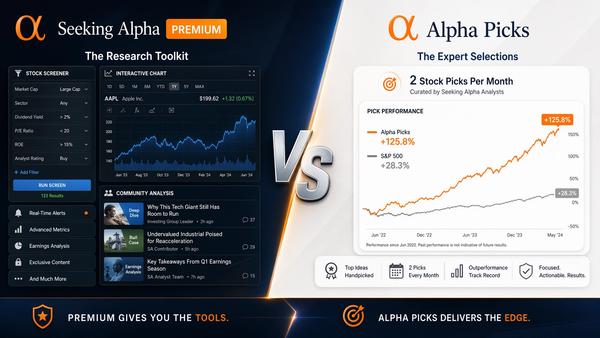
Seeking Alpha's Alpha Picks service is by far the top performer when compared against multiple Zacks subscriptions tracked over the last three years, beating the S&P 500 by an average of 47% across the period.
Zacks has its own performance history. Zacks boasts that their strong buy #1 rank stocks have had a 24.5% average return since 1988. That is a long track record, though critics note that the Zacks Rank system was built around a market inefficiency that is now widely known and partly priced in.
Asset Class Coverage
Both platforms cover stocks, ETFs, and mutual funds. Seeking Alpha also includes commodities and cryptocurrencies. Both offer real-time market data, making either suitable for active trading strategies where timing matters.
On data exports, Seeking Alpha supports data exports to Excel and PDF, while Zacks has more limited export options.
People Also Ask
Q: Is Seeking Alpha better than Zacks?
Seeking Alpha is a better service than Zacks for most investors. Zacks remains very surface-level, while Seeking Alpha offers in-depth research analysis performed by many highly-educated investors which you can use to guide your own investment decisions. That said, Zacks is a better fit if you want a single, clean research report on a stock from a dedicated in-house analyst.
Q: What is the Zacks Rank system and how does it work?
Zacks was founded on the discovery that when Wall Street analysts adjusted their earnings estimates, stock prices tended to follow in the near- to medium-term. Every stock is ranked from 1 to 5, with 1 being a strong buy. The ranking is driven primarily by the direction and magnitude of analyst earnings estimate revisions, not by broader fundamental factors.
Q: Does Seeking Alpha include Zacks Rank data?
Yes. Seeking Alpha shows analysts' estimate revisions alongside all of its other data points, so a subscription to Seeking Alpha also includes the core data that the Zacks Rank system is built on. This means Seeking Alpha Premium effectively absorbs Zacks' main value proposition while adding far more on top.
Q: Which platform is better for short-term traders?
Zacks is best suited for traders and people who want to make data-driven decisions based on earnings revisions and short-term momentum. Seeking Alpha is more suited to investors with a medium to long-term horizon who want to read detailed analysis and use a comprehensive quant screener to build and monitor a portfolio.
Q: Can I track my portfolio on both Seeking Alpha and Zacks?
Both platforms include portfolio tracking, so you can monitor your holdings, performance, and allocation in one place. Seeking Alpha additionally allows you to sync an external brokerage account and receive alerts when a stock in your portfolio changes its Quant Rating — a feature Zacks does not offer.
Which One Should You Choose?
Zacks is the better option if you want a traditional stock research report — a single report that is relatively easy to read and presents a professional analyst's view of a company they have been following for many years. Each report contains a deep dive into the company and a look at its fundamentals and growth potential.
Seeking Alpha wins if you want depth, variety, and a more powerful quantitative layer. The Quant Rating system covers over 100 metrics, the contributor base covers thousands of stocks with multiple viewpoints, and the platform's performance data — validated by an independent academic study in 2024 — gives it more credibility than most competitors can claim.
For most self-directed investors doing their own research, Seeking Alpha Premium at around $269 per year offers more tools, more data, and a better-proven rating system than Zacks Premium at a similar price point. Zacks remains a solid option for investors who prefer clean, single-analyst reports and want to trade around earnings estimate changes specifically.