Zacks vs Morningstar vs Motley Fool vs Seeking Alpha: Which Investment Research Platform Is Right for You?
Zacks vs Morningstar vs Motley Fool vs Seeking Alpha – compare rankings, star ratings, stock picks and Quant Ratings to find the best investment research platform.

Zacks vs Morningstar vs Motley Fool vs Seeking Alpha ultimate comparison – find out which stock research platform is right for your investment strategy in 2025Choosing a stock research platform is not as simple as picking the one with the most features. Each of the four major services — Zacks, Morningstar, Motley Fool, and Seeking Alpha — was built for a different kind of investor. One rewards people who want curated picks delivered to their inbox. Another suits the type who wants to dig through earnings data on a Saturday morning. The right answer depends entirely on how you invest and what you need from a subscription.
Here is an honest, side-by-side look at all four.
What Is Motley Fool?
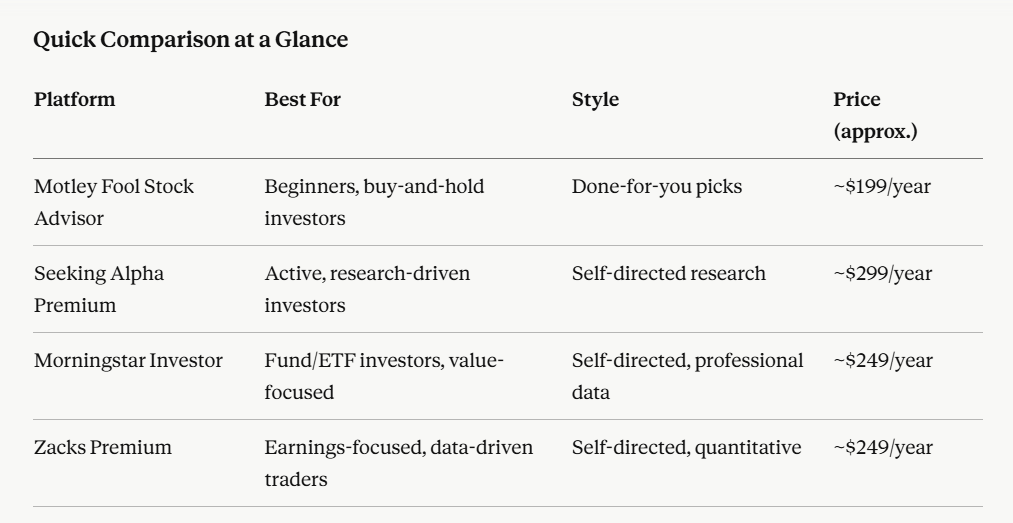
The Motley Fool was founded in 1993 and has since helped hundreds of thousands of investors reach financial independence through its website, content, and premium investing services. Its flagship product, Stock Advisor, delivers two stock picks per month chosen by the in-house analyst team. These picks focus on long-term growth, meaning the service does not tell you when to sell or trade frequently.
Motley Fool Stock Advisor claims an average annual return of around 24%, and its cumulative performance over two decades has beaten the S&P 500 by a significant margin. The platform is straightforward to use and does not overwhelm subscribers with data. You get a recommendation, a research report explaining the reasoning, and a list of prior picks you can still buy.
Who should use it: Anyone new to investing or anyone who does not want to spend hours doing their own stock research. It is essentially a managed opinion service with a solid long-term track record.
What Is Seeking Alpha?
Seeking Alpha is an investment research website that provides fundamental data, news, stock screeners, portfolio tools, and a quantitative stock grading system — all the tools necessary for investors to perform their own due diligence. The website is best known for its comprehensive investment research, crowdsourced from more than 18,000 experienced investors and analysts who collectively produce more than 10,000 research reports per month.
Seeking Alpha Premium offers the strongest stock ratings because it has three types of ratings: Wall Street analyst ratings, Seeking Alpha author ratings, and objective quant ratings. It also publishes management conference call transcripts, which are particularly useful for tracking company outlook and quarterly performance in the words of the executives themselves.
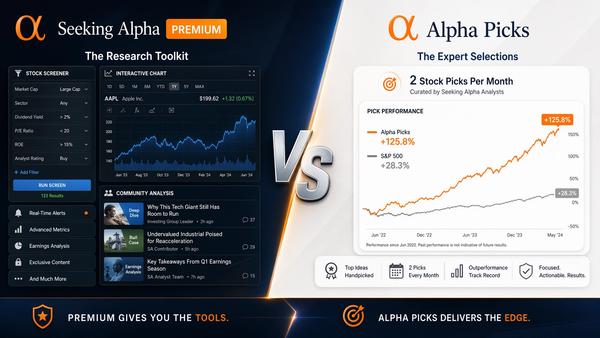
Seeking Alpha's Alpha Picks service has posted a three-year annualized return of around 53%, making it one of the strongest-performing stock-picking services currently available.
Who should use it: Intermediate to advanced investors who enjoy doing their own research and want access to a wide variety of opinions, data, and screeners in one place.
What Is Morningstar?
Morningstar is best known for its independent, objective research. Unlike Seeking Alpha, which crowdsources its investment research from third-party contributors, all of Morningstar's analysis is written in-house by its team of professionals. It caters to a slightly more sophisticated investor and is frequently used by financial advisors and other professionals.
Morningstar is widely considered one of the best resources for mutual fund and ETF data. Its premium service gives you access to in-depth analysis and widely respected ratings from over 150 Morningstar analysts, along with the ability to screen stocks, mutual funds, and ETFs based on crucial data points.
Its portfolio tools are particularly well-regarded. You can link brokerage accounts, track asset allocation, and get a clear picture of diversification across your holdings. The star rating system (1 to 5 stars) assigns fair value estimates to stocks, which is especially useful for value investors who want to know whether a stock is overpriced before buying.
Who should use it: Long-term investors with a focus on mutual funds, ETFs, or bonds, or anyone who wants professional-grade, objective research without the noise of crowdsourced opinions.
What Is Zacks?
Zacks is the ideal platform for data-driven investors. It offers financial reports, earnings call transcripts, ratings, and expert-level analysis to help users choose investments. The core of the Zacks system is its proprietary rank, which rates stocks from 1 (Strong Buy) to 5 (Strong Sell) based purely on earnings estimate revisions. The idea is straightforward: when analysts start raising their earnings expectations for a company, that stock tends to move up.
Zacks Premium has a proprietary mutual fund ranking system and covers nearly 19,000 mutual funds, which they rate on a one-to-five scale. Its free tools are genuinely useful, and many investors use the Zacks rank without ever paying for the premium tier.
You can look up an unlimited number of stocks on Zacks and get their Zacks Rank without paying for Premium, which reduces the value proposition of the paid subscription for many users.
Who should use it: Short-term and data-focused traders who base decisions on earnings momentum. Less suitable for investors who want broad, narrative-driven analysis.
Frequently Asked Questions
Q: Which is better for beginners — Motley Fool or Seeking Alpha?
For beginners, Motley Fool is the stronger choice. If you're new to the stock market and want to pay for a service with a track record of outperformance, Motley Fool Stock Advisor is the best option. For investors who want to actively research and develop their own investment thesis, a Seeking Alpha Premium subscription is an unmatched service.
Q: Is Morningstar better than Zacks?
For most investors, yes. Morningstar's portfolio tools are exceptional and can give unparalleled insights into portfolio composition. Zacks, on the other hand, remains fairly surface-level in its analysis. Morningstar also covers mutual funds and ETFs in far greater depth than Zacks
Q: Can I use more than one of these platforms at the same time?
Yes, but it is important to make sure you are not spending more than you can afford — or more than you are earning from your investments. If you want Motley Fool's picks but also want access to in-depth research, you might benefit from two subscriptions. Many active investors combine Morningstar for fund research with Seeking Alpha for individual stock analysis.
Q: Is Zacks Premium worth the cost?
Based on performance disclosures from Zacks itself, investors should not expect to replicate the results the system advertises. Given that the Zacks Rank is available for free and Seeking Alpha also shows earnings estimate revisions as part of its data, many investors find little reason to pay for Zacks Premium.
Q: Which platform has the best track record for stock picks?
Testing of leading stock-picking services shows that Seeking Alpha's Alpha Picks leads with a 53% annualized return over three years, outperforming competitors by a wide margin. Motley Fool's Stock Advisor follows with around 24% per year, supported by a long-term verified track record. Both services provide recommendations that have historically beaten the broader market.
Which One Should You Choose?
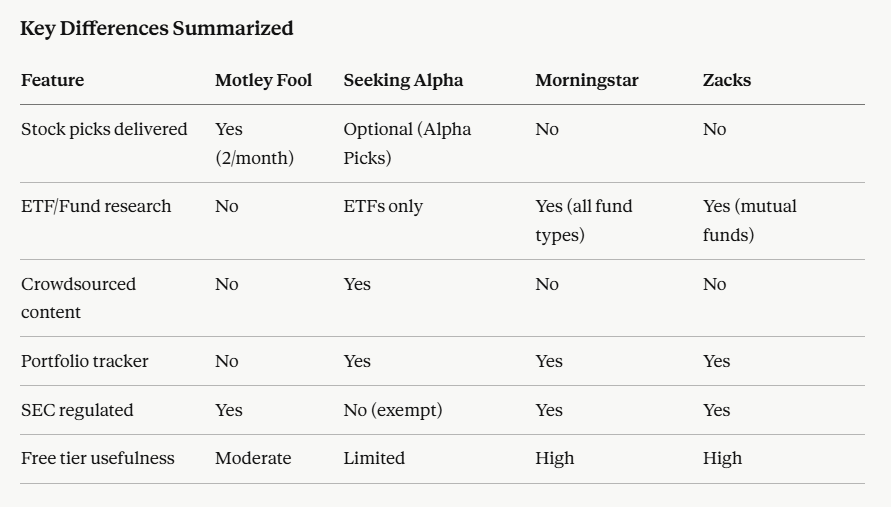
The honest answer is that none of these platforms is universally best. Zacks is best for data-driven decisions, Morningstar is best for value investors, and Seeking Alpha has the most variety plus a unique community element. Motley Fool fills a specific gap for people who want expert stock recommendations without spending time doing independent research.
If you are just starting out and want reliable monthly picks, go with Motley Fool. If you are a self-directed investor who wants to read deep analysis across thousands of stocks, Seeking Alpha gives you the most comprehensive toolkit. If you manage a portfolio heavy in mutual funds or ETFs, Morningstar is the most professional and objective option available. And if your investment decisions revolve around earnings trends and quantitative signals, Zacks has the most focused system for that purpose — though much of its value is available without paying for premium access.
The best move for many investors is to start with a free trial of whichever platform fits their style, spend a week actually using the tools, and let the experience decide.